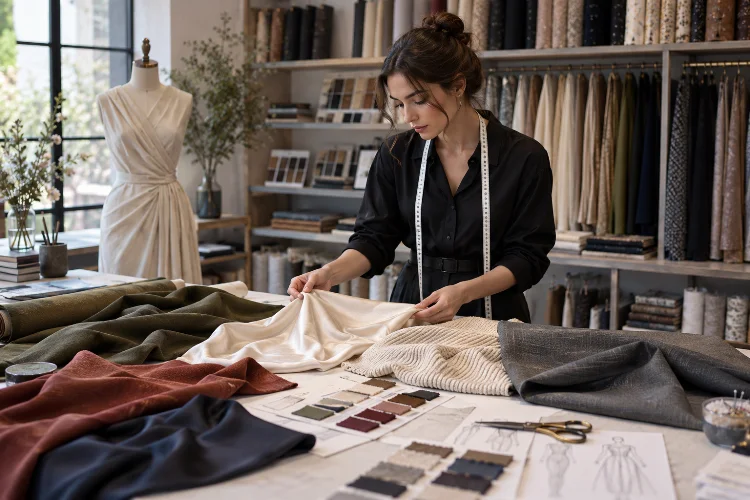
A beautiful garment can begin with an excellent sketch and still fail because of one decision: the wrong fabric.
Imagine designing a structured blazer in a material that collapses too easily, or creating fitted sportswear from a fabric that barely stretches. The design might look perfect on paper, but textiles determine how clothing actually hangs, moves, feels, and survives everyday wear.
That is why essential textile knowledge every fashion designer should develop goes far beyond memorizing the names of cotton, silk, wool, and polyester.
Designers need to understand how fibers become yarns, how yarns become fabrics, and how construction, weight, finishing, and performance affect the final garment.
CottonWorks, for example, teaches textile fundamentals as an interconnected process covering fiber science, yarn formation, knitting, weaving, dyeing, and finishing because each stage can influence the properties of the finished product.
You do not need to become a textile engineer. But knowing how fabric behaves gives you far more control over what you design.
1. Start by Understanding Fibers
Every textile begins with fiber.
Fibers may come from plants, animals, regenerated cellulose, or synthetic materials. Cotton, linen, wool, silk, polyester, nylon, and lyocell all behave differently because their physical and chemical structures are different.
A designer should learn to connect fiber type with practical characteristics such as softness, strength, moisture absorption, elasticity, warmth, durability, and care requirements.
Wool, for instance, can absorb a significant amount of moisture while helping manage humidity around the body. The International Wool Textile Organisation states that wool can absorb up to around 35% of its own weight in moisture before releasing it as vapor.
Polyester offers another set of properties and dominates global fiber production. Textile Exchange reported that polyester represented about 59% of global fiber output in 2024.
Knowing the fiber helps designers predict how a material might perform before they even start cutting it.
2. Learn How Yarn Changes Fabric Character
Fiber is only the beginning.
Fibers are often spun or otherwise formed into yarn, and the structure of that yarn can strongly affect the finished textile. Thickness, twist, fiber length, texture, and the number of yarns combined together can influence appearance and performance.
A tightly twisted yarn may create a different surface from a soft, loosely spun yarn. Fine yarns can produce lightweight and refined fabrics, while thicker yarns can create heavier or more textured materials.
This is why two fabrics made from the same fiber do not necessarily feel alike.
A cotton T-shirt, cotton canvas jacket, and lightweight cotton shirt may all contain the same basic fiber, yet their yarn construction and fabric structure create completely different results.
For designers, the practical lesson is simple: never judge fabric only by its fiber-content label.
Develop your textile knowlege by touching different yarns and fabrics and comparing their structure.
3. Understand the Difference Between Woven and Knitted Fabrics
One of the most important textile distinctions is between woven and knitted construction.
Woven fabrics are formed by interlacing two sets of yarns. The lengthwise yarns are called warp, while the crosswise yarns are known as weft or filling yarns.
The three foundational woven structures are plain, twill, and satin. These structures can produce dramatically different surfaces, drape, strength, and visual effects.
Knitted fabrics, by comparison, are created through intermeshing yarn loops.
Because those loops can change shape, knits generally provide more natural flexibility and stretch than many woven materials.
CottonWorks notes that this ability to conform to the body makes knit fabrics especially useful for clothing requiring comfort and movement, including T-shirts, leggings, sports bras, hoodies, and activewear.
Understanding this structural difference helps designers choose fabrics according to how a garment needs to behave.
4. Pay Attention to Weight, Drape, and Hand Feel
Textile selection becomes much more useful when designers stop thinking only in terms of fabric names.
Consider weight. Lightweight chiffon behaves differently from heavy denim, even before you consider fiber composition.
Then there is drape, which describes how a material hangs and falls. A fluid fabric may create soft folds around the body, while a stiffer textile may hold architectural shapes.
Hand feel, sometimes simply called hand, describes the sensory experience of touching a fabric. It may feel smooth, rough, crisp, soft, dry, fuzzy, cool, or slippery.
These caracteristics influence the emotional quality of a garment as much as its technical performance.
A structured coat may require enough body to maintain its silhouette. A flowing evening dress usually needs more movement. Trying to force one material to behave like the other can lead to unnecessary construction problems.
Professional designers learn to let fabric properties guide the design instead of fighting them.
5. Stretch and Recovery Matter More Than You Might Expect
Stretch is not only important for gym clothes.
It influences comfort, fit, movement, and garment construction across many fashion categories.
Some textiles stretch because of their structure. Knitted fabrics naturally have greater flexibility because their yarns form loops. Other fabrics gain stretch through elastic fibers such as elastane.
However, stretch and recovery are not the same thing.
Stretch describes how far a textile can extend. Recovery describes how effectively it returns toward its original dimensions afterward.
Imagine fitted trousers that stretch beautifully when first worn but gradually remain loose around the knees. The material has stretch but poor recovery for that application.
Designers should test fabrics physically. Stretch them in different directions, observe how quickly they return, and consider whether the pattern needs negative ease, additional support, or a completely different material.
6. Fabric Finishing Can Transform Performance
A textile is not necessarily finished when it comes off a loom or knitting machine.
Manufacturers can apply mechanical or chemical processes that significantly change its appearance and performance.
Finishing may influence softness, shrinkage, wrinkle resistance, surface texture, water behavior, color appearance, or durability.
CottonWorks includes preparation, dyeing, printing, and finishing as major areas of textile development precisely because these later processes affect the final material.
A fabric can therefore look and feel very different before and after finishing.
Designers should ask suppliers about treatments instead of assuming every property comes naturally from the fiber.
This becomes especially important when developing performance clothing. Water repellency, brushed surfaces, wrinkle resistance, or moisture-management features may depend partly on fabric engineering rather than fiber choice alone.
Understanding those processes allows designers to communicate with textile suppliers more effectively.
7. Always Match Textile Performance to the Garment
The “best” textile depends on what you are designing.
A breathable summer shirt needs different properties from a winter coat. Running tights need stretch and recovery, while tailored trousers require stability, appropriate drape, and good shape retention.
Start by imagining the garment in use.
Will the wearer sit for eight hours? Run outdoors? Travel with the garment packed inside a suitcase? Wear it directly against the skin? Wash it every few days?
These questions make textile selection practical.
Designers should also consider opacity, abrasion resistance, pilling, colorfastness, shrinkage, thermal comfort, moisture behavior, and cleaning requirements where relevant.
A fabric may look spectacular in a studio but become unsuitable if it shrinks dramatically after washing or feels uncomfortable during extended wear.
Textile decisions should therefore happen early in the creative process, not as a seperate step after the design has already been finalized.
8. Sustainability Requires Looking Beyond the Fabric Name
Sustainable textile selection is more complicated than choosing “natural” instead of “synthetic.”
The global fiber industry uses enormous volumes of material. Textile Exchange estimated approximately 132 million tonnes of fiber production worldwide in 2024, more than double the level recorded in 2000.
Designers therefore need to think about sourcing as well as aesthetics.
Questions may include where fibers came from, whether recycled content is available, how the textile was processed, how durable it is, and what might happen to the garment at the end of its useful life.
Recycling also remains challenging. Textile Exchange reported that less than 1% of the global fiber market in its 2023 data came from pre- and post-consumer recycled textiles.
Material selection alone cannot solve fashion’s environmental challenges.
A durable garment designed for repeated use may sometimes be more meaningful than chasing a fashionable sustainability label without examining the full product lifecycle.
Build Textile Knowledge Through Hands-On Practice
Reading about fabrics helps, but designers learn a huge amount by physically working with materials.
Build your own fabric library.
Keep small swatches and record fiber content, construction, approximate weight, stretch, drape, texture, supplier information, and possible applications. Over time, you develop a personal reference system that makes sourcing much faster.
Wash-test materials when appropriate. Cut them. Sew seams through them. Press them. Stretch them and observe how they recover.
This type of experimentation teaches something a computer screen cannot: how textiles behave in your hands.
A designer with strong fabric understanding can often look at an inspiration sketch and quickly identify which materials might make the concept realistic.
That is an incredibly valuable skill in professional fashion manufactering and product development.
Essential textile knowledge every fashion designer should develop begins with understanding that fabric is not simply the surface placed over a design. It is one of the things creating the design in the first place.
Fiber influences performance, yarn affects character, and woven or knitted construction changes stability and stretch. Weight, drape, finishing, recovery, durability, and sourcing then determine whether the textile actually works for the intended garment.
The fastest way to improve is to combine theory with physical experimentation.
Start collecting swatches, compare similar fibers in different constructions, and document how materials respond to stretching, washing, pressing, and sewing.
The better you understand textiles, the easier it becomes to create garments that not only look convincing on paper but also perform beautifully in the real world.