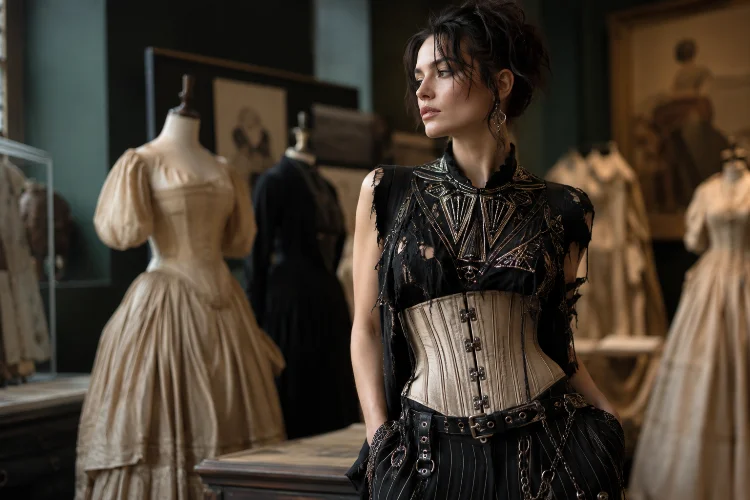
Open almost any contemporary runway collection and you may find something surprisingly familiar.
A dramatic corseted waist might recall Victorian fashion, geometric embellishment can echo Art Deco, while ripped fabrics, safety pins, and distressed finishes immediately bring the punk movement to mind.
Fashion constantly looks forward, but it rarely completely leaves the past behind.
Historical fashion movements provide designers with a huge visual archive of silhouettes, construction techniques, cultural symbols, materials, and attitudes that can be reshaped for modern audiences.
The interesting part is that designers usually do not copy history exactly. Instead, they select an idea, remove it from its original context, and adapt it to contemporary lifestyles.
A nineteenth-century corset might become a lightweight top, while a 1970s punk jacket could inspire a luxury runway piece.
Understanding these connections helps explain why fashion trends seem to disappear and then suddenly return. More importantly, it shows that fashion history is not simply something stored in museums-it remains an active part of how designers create today.
1. Victorian Fashion Still Shapes Modern Silhouettes
Victorian clothing is remembered for dramatic proportions, structured corsetry, elaborate decoration, full skirts, and carefully constructed garments.
The Metropolitan Museum of Art notes that Victorian dress developed increasingly elaborate forms, including molded corsets and large domed skirts supported by evolving dressmaking techniques.
Those proportions continue to influence contemporary fashion.
Corset-inspired tops regularly appear in eveningwear, bridal collections, street fashion, and even casual clothing.
Designers may remove the rigid construction associated with historical corsetry while keeping features such as boning, shaped seams, fitted waists, or lace-up details.
Large sleeves are another obvious example. Puff sleeves, exaggerated shoulders, high collars, and floor-length skirts frequently return to fashion because they create powerful silhouttes without requiring excessive decoration.
Historical Shape, Modern Comfort
Modern designers often borrow the visual drama of Victorian clothing while changing its function.
A historical corset might have been designed to reshape the body, while a contemporary corset-inspired garment may use stretch fabric, flexible boning, or decorative seams.
The historical reference remains recognizable, but comfort and movement become much more important.
This approach demonstrates one of fashion’s most useful creative techniques: borrow the visual language without reproducing every historical rule.
2. Early Modernism Changed the Way Designers Thought About the Body
The early twentieth century introduced major changes in fashion construction. Designers increasingly experimented with looser forms and clothing that moved away from some of the rigid structures of nineteenth-century dress.
Paul Poiret became particularly important during this transition.
The Metropolitan Museum of Art explains that his approach emphasized draping fabric directly on the body and using straighter cuts rather than depending entirely on conventional tailoring and patternmaking.
That philosophy feels surprisingly modern.
Many contemporary designers still experiment by draping fabric directly onto mannequins or models. Instead of beginning with a detailed illustration, they allow the behavior of the textile to guide the shape.
Loose tunics, column dresses, cocoon silhouettes, and fluid layering all connect to this broader movement toward freeing clothing from rigid structures.
For fashion students, this is an important lesson. Sometimes innovation comes not from adding more details but from questioning how garments are traditionally constructed.
3. Art Deco Keeps Bringing Geometry and Glamour Back
The Art Deco movement of the 1920s and 1930s connected fashion with architecture, art, technology, nightlife, and modern urban culture.
The Victoria and Albert Museum highlights how designers such as Jeanne Lanvin combined fluid forms with strong geometric elements. Art Deco fashion also featured bold patterns, reflective surfaces, luxurious materials, and increasingly simplified shapes.
You can still recognize this influence in contemporary eveningwear.
Metallic fabrics, symmetrical embroidery, geometric beading, sharp panel lines, and glamorous black-and-gold combinations frequently reference Art Deco aesthetics.
Costume designers also use these visual codes when they want to communicate luxury associated with the Jazz Age.
Modern designers do not need to reproduce a 1920s dress exactly. They might reinterpet geometric decoration as laser-cut fabric, digital prints, structured handbags, or minimalist jewelry.
This is how historical design language evolves rather than simply repeats itself.
4. Dior’s New Look Continues to Define Ideas of Elegance
After years of wartime restrictions, Christian Dior introduced his famous New Look in 1947.
The silhouette emphasized sloping shoulders, a defined waist, and dramatically full skirts. According to the V&A, the collection helped launch what became known as a “golden age” of couture and strongly influenced postwar fashion.
The formula remains influential because its proportions are instantly recognizable.
Modern designers regularly revisit the fitted-jacket-and-full-skirt combination. You can see variations in couture, bridal fashion, red-carpet dresses, and contemporary womenswear.
Even when the skirt becomes shorter or the jacket oversized, the underlying principle remains useful: designers can manipulate the relationship between shoulders, waist, and lower-body volume to create a specific visual effect.
Studying the New Look therefore teaches more than fashion history. It teaches proportion.
5. The 1960s Made Youth Culture a Fashion Power
Before the 1960s, high fashion was often strongly controlled by established designers and wealthy customers. The decade helped shift attention toward younger consumers, street culture, music, and more affordable clothing.
The V&A describes London’s boutiques around King’s Road and Carnaby Street as major spaces for youthful experimentation. Designers including Mary Quant helped popularize short hemlines, bright colors, playful separates, and clothing suited to an energetic urban lifestyle.
That change still matters today.
Fashion trends increasingly emerge from communities, music scenes, social platforms, and street style rather than flowing only from luxury houses downward.
The 1960s also encouraged experimentation with synthetic materials such as PVC, polyester, nylon, and acrylic.
That enthusiasm for new materials can be compared with today’s experiments involving recycled fibers, biomaterials, 3D printing, and digitally developed textiles.
Different technology, similar curiosity.
6. Punk Proved That Rebellion Could Become Fashion
Few movements demonstrate the relationship between culture and clothing more clearly than punk.
Emerging during the 1970s, punk rejected polished mainstream style through ripped garments, safety pins, provocative graphics, leather, chains, unusual construction, and deliberate imperfection.
Vivienne Westwood became one of the designers most closely connected with this visual language. The V&A documents how her early work with Malcolm McLaren helped turn London’s rebellious youth culture into a distinctive fashion aesthetic.
The Met has also explored how punk’s do-it-yourself attitude later influenced both ready-to-wear and haute couture. Designers adopted techniques involving destruction, hardware, bricolage, graffiti, and deliberately unfinished surfaces.
Today, distressed denim, exposed seams, deconstructed jackets, safety-pin jewelry, graphic T-shirts, and intentionally damaged luxury garments still carry that rebelious visual energy.
Ironically, an anti-fashion movement became one of fashion’s most enduring sources of inspiration.
7. Modern Designers Mix Historical Eras Instead of Copying Them
Perhaps the biggest influence of fashion history today is not one particular period. It is the freedom to combine multiple periods within one collection.
A designer might pair Victorian sleeves with punk hardware, 1960s mini proportions, and futuristic synthetic textiles. Another could take eighteenth-century tailoring and transform it into oversized streetwear.
Vivienne Westwood was especially known for this approach. The V&A describes how she repeatedly explored historic dress, traditional tailoring, tartan, corsetry, crinolines, and older European silhouettes while transforming them through her own design perspective.
This process is sometimes described as historical referencing or reinterpretation.
For emerging designers, the important lesson is to research beyond Pinterest trends. Visit museum collections online, study historical patterns, examine construction methods, and understand the social context behind clothing.
Then ask: what can this idea become today?
Good historical inspiration does not make a collection look old. It gives designers more material to create something new.
Historical fashion movements continue to influence design because the past contains an enormous library of ideas.
Victorian structure, early twentieth-century draping, Art Deco geometry, Dior’s postwar proportions, 1960s youth culture, and punk rebellion all introduced concepts that designers continue to transform.
Fashion history therefore should not be treated as a collection of outdated clothes. It is a creative resource filled with lessons about construction, culture, identity, proportion, materials, and social change.
If you are learning fashon design, start studying one historical movement that genuinely interests you.
Examine its shapes, fabrics, construction, and cultural meaning, then experiment with translating those elements into something relevant today. The goal is not to recreate history-it is to continue the conversation.