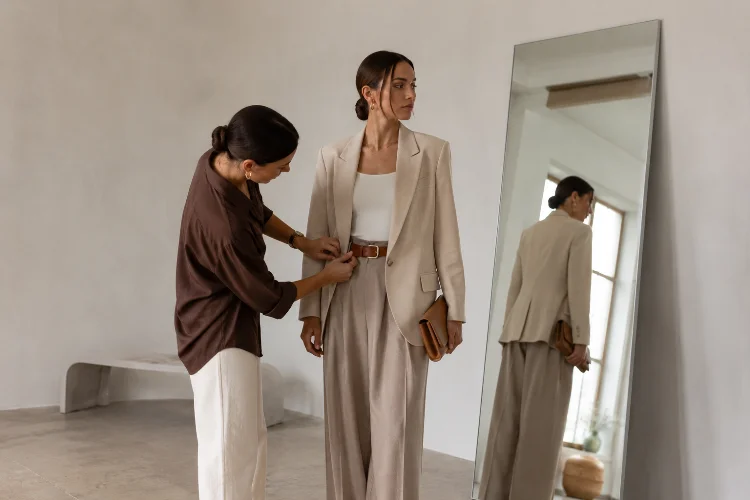
Have you ever put together an outfit where every individual piece looked good, but somehow the whole look still felt wrong? The problem may not be the clothes themselves. Often, it comes down to balance, proportion, and harmony.
These three design principles play a major role in how an outfit feels visually. They influence whether a jacket looks too heavy for a pair of trousers, whether accessories overwhelm the wearer, or whether different colors and textures feel intentionally connected.
Understanding balance, proportion, and harmony in fashion styling does not mean following strict rules or dressing for one specific body type.
Instead, it gives you practical tools for understanding why certain combinations feel cohesive while others appear awkward or unfinished.
Fashion designers and stylists use these principles to control visual weight, scale, silhouette, emphasis, and movement. Once you learn how they work, you can start evaluating outfits more deliberately-and make styling decisions based on visual logic rather than guesswork.
1. Understand Balance as Visual Weight
Balance in fashion is about how visual weight is distributed across an outfit.
According to Utah State University Extension, balance occurs when the different parts of a garment or ensemble create a sense of visual equilibrium. Color, texture, line, decoration, and structural details can all affect that balance.
Imagine wearing a heavily structured oversized blazer with extremely delicate shoes and nothing visually substantial on the lower half. The outfit may feel top-heavy because most of the visual weight sits around the shoulders and torso.
You could restore balance by introducing wider trousers, heavier footwear, a longer skirt, or another strong element lower in the outfit.
Visual weight does not depend only on physical size. Dark colors, thick textures, large patterns, metallic details, and highly structured garments can appear visually heavier than lighter, softer, or simpler pieces.
That is why a small black leather bag can sometimes attract more attention than a much larger cream canvas tote.
2. Use Symmetrical and Asymmetrical Balance Differently
Not every balanced outfit needs to look perfectly symmetrical.
Symmetrical balance occurs when both sides of a design have similar visual weight. A classic blazer with matching lapels, evenly positioned pockets, and centered buttons is an easy example.
The Museum at FIT describes symmetrical balance as a design in which elements on either side appear equal, while asymmetrical balance achieves equilibrium through different visual elements rather than identical ones.
Asymmetrical balance, meanwhile, can make styling feel more dynamic.
You might wear an off-the-shoulder top, carry a bag on one side, or use a skirt with an uneven hem. Although both sides are different, the look can still feel stable if other elements compensate for the difference.
For example, a dramatic ruffle on one shoulder might be visually balanced by a bold bracelet or structured handbag lower on the opposite side.
Do not confuse asymetrical styling with random placement. Good asymmetry still feels intentional.
3. Understand Proportion as the Relationship Between Parts
Proportion is one of the most useful concepts in everyday styling because it deals with the relationship between different parts of an outfit.
Utah State University defines proportion as the size or spatial relationship between individual parts of a design and the overall garment or ensemble.
Think about a cropped jacket worn with high-waisted wide-leg trousers. The short upper section and longer lower section create a specific visual ratio.
Now replace the jacket with a long oversized coat. Suddenly, the outfit creates completely different proprotions, even though the trousers remain unchanged.
This is why changing only one garment can dramatically transform an outfit.
Think in Visual Ratios
You do not need to calculate exact mathematical ratios every morning.
Instead, look at where clothing visually divides the body. Waistbands, jacket hems, boots, color changes, belts, and layered pieces all create horizontal breaks.
A top ending directly at the midpoint of an outfit may sometimes feel static, while uneven divisions can create more movement.
Educational material on apparel design often emphasizes that proportion involves comparing the sizes and divisions of different parts of a garment or ensemble rather than evaluating each item independently.
The practical question is simple: does one section unintentionally dominate everything else?
4. Match Scale to the Overall Outfit
Scale is closely connected to proportion but focuses more directly on relative size.
A tiny handbag paired with a giant puffer jacket creates a very different impression from an oversized tote paired with the same jacket.
Neither combination is automatically wrong.
The important question is whether the difference in scale supports the intended style.
The Fashion Institute of Technology teaches proportion, garment silhouette, design details, and visual presentation as connected elements within fashion design education.
Accessories are especially useful for experimenting with scale.
Large earrings can become a focal point against a minimal outfit. Chunky sneakers can visually support wide-leg trousers, while narrow shoes may make the same trousers appear even larger.
Try comparing your accesories not only with your body but also with the volume of your clothing.
A small necklace may disappear against an oversized knit, while the same necklace could work perfectly with a clean fitted neckline.
5. Create Harmony Through Color, Texture, and Shape
Harmony is what happens when the different elements of an outfit feel like they belong together.
Utah State University explains that harmony is created when elements such as color, shape, line, and texture work successfully with principles including balance and proportion to create visual unity.
That does not mean everything must match.
An outfit can contain contrasting materials, different colors, or unusual shapes and still feel harmonious if there is some visual connection between them.
For example, consider a cream knit sweater, dark brown leather trousers, and tan suede boots. The materials differ, but their warm neutral palette helps connect the look.
Alternatively, you might wear a bright red bag with a neutral outfit. The bag does not match everything else, but repeating a subtle red detail in jewelry, shoes, or makeup can create a visual relationship.
Color deserves special attention because it changes mood, emphasis, and perceived visual weight. FIT’s textile design curriculum includes color theory and explores how color influences meaning and design decisions.
Harmony comes from connection, not sameness.
6. Use Silhouette and Layering to Control Proportion
Layering is one of the easiest places for proportions to go wrong.
Imagine wearing a long shirt, a long cardigan, a long coat, and wide trousers. Individually, every item might be attractive, but together they may create so many similar vertical lengths that the outfit loses definition.
Introducing different lengths can make the composition more interesting.
You might combine a cropped jacket with a longer shirt or wear a fitted top underneath a voluminous coat. The contrast creates clearer visual structure.
Silhouette is especially important here.
The Museum at FIT describes silhouette as the overall outline of a garment and notes that it creates one of the viewer’s first impressions.
Before focusing on small details, look at your outfit from a distance.
Is the upper half extremely wide while the lower half feels narrow? Does everything have the same oversized shape? Is there one clear focal point, or are several dramatic pieces competing for attention?
Looking at the outline often reveals styling problems much faster than examining individual garments.
7. Let Harmony Include Personal Style
Fashion principles are useful, but they are not mathematical laws.
Harmony is partly subjective. What feels visually balanced in minimalist fashion may look completely different in maximalist styling, avant-garde design, punk, or streetwear.
Historical fashion guidance has long treated balance, rhythm, harmony, proportion, and emphasis as tools for helping people organize clothing visually.
The Smithsonian’s record for The Lost Art of Dress, for example, documents how twentieth-century dress educators taught these principles as part of practical clothing knowledge.
However, modern styling allows much more deliberate rule-breaking.
Rei Kawakubo, for example, is known for challenging conventional ideas of body shape, construction, and proportion. The Metropolitan Museum of Art describes her work as a continued exploration of form and construction rather than traditional fashion conventions.
That offers an important lesson: understanding a principle gives you more freedom to break it intentionally.
An exaggerated shoulder, oversized coat, tiny handbag, or deliberately mismatched silhouette can work because imbalance itself becomes part of the concept.
The difference between intentional disruption and accidental awkwardness usually comes from awareness.
8. Use a Simple Styling Check Before Leaving
You can apply these principles without turning dressing into a complicated design exercise.
Once you have assembled an outfit, step away from the mirror and look at the entire silhouette instead of focusing on individual pieces.
Ask yourself whether one area feels unexpectedly heavy. Check whether garment lengths divide the outfit in a pleasing way. Look at whether colors, materials, and accessories share enough visual relationships to create cohesivness.
Then identify the focal point.
If you are wearing statement boots, a patterned coat, oversized jewelry, a dramatic bag, and a bright hat at the same time, several elements may compete for attention.
Removing one item can sometimes improve an outfit more effectively than adding another.
Photographing the look can also help. A photo reduces the tendency to focus on specific details and makes overall proportion much easier to notice.
Over time, this evaluation becomes instinctive.
Understanding balance, proportion, and harmony in fashion styling gives you a framework for creating outfits that feel intentional rather than randomly assembled.
Balance controls visual weight, proportion manages the relationships between sizes and lengths, while harmony brings colors, textures, silhouettes, and accessories into a connected whole.
These principles are not meant to restrict creativity. In fact, knowing them makes experimentation easier because you can understand exactly what happens when you change a jacket length, exaggerate a silhouette, introduce contrast, or shift the visual focal point.
Start by analyzing outfits you already own. Change one element at a time and observe how the overall look responds. The more you practice seeing fashion through visual relationships, the more confident and flexible your personal styling decisions can become.