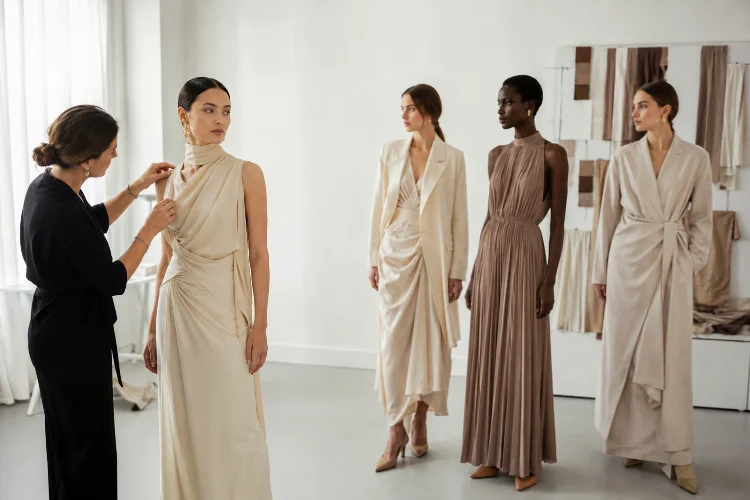
Designing one strong outfit is challenging. Designing ten or fifteen looks that feel different enough to stay interesting but connected enough to belong in the same collection is a completely different skill.
That is where collection planning becomes important.
Learning how to plan a cohesive fashion collection from concept to final look means thinking beyond individual garments.
You need a clear concept, recognizable visual language, consistent materials and colors, balanced product categories, and enough variation to keep the collection moving forward. Professional fashion education follows a similar process.
Central Saint Martins’ collection-development training, for example, moves from defining a target market and researching a theme to selecting fabrics, colors, silhouettes, range planning, storyboarding, and refining the final collection.
A cohesive collection should feel like several chapters from the same story rather than unrelated outfits placed next to each other.
The good news is that cohesion can be planned. Once you know what to repeat, what to vary, and what to remove, building a strong collection becomes far more manageable.
1. Define the Purpose and Customer First
Before choosing colors or drawing silhouettes, ask a basic question: Who is this collection for?
A luxury eveningwear collection requires different fabrics, prices, construction methods, and styling from casual streetwear. Similarly, clothing designed for tropical climates has different functional requirements from an autumn outerwear collection.
Central Saint Martins specifically includes establishing the collection’s purpose and target market as an early stage of collection development. FIT also teaches fashion students to analyze target markets while creating portfolio collections.
You do not need to create an imaginary customer with dozens of unnecessary details. Focus on information that actually affects design.
Consider lifestyle, age range, climate, occasion, expected price level, and how experimental or commercial the customer is willing to be.
For example, imagine you are creating contemporary workwear for young creative professionals.
This immediately suggests useful questions about comfort, layering, office flexibility, commuting, storage, and the balance between professional and expressive dressing.
Those decisions give your collection a practical foundation.
2. Build a Concept Strong Enough to Generate Multiple Looks
A concept should offer more than one obvious design idea.
If your theme is simply “flowers,” you may quickly end up putting floral prints on everything. A stronger concept might investigate flowers through growth, decay, transparency, organic structure, or changing seasonal colors.
Central Saint Martins describes inspiration as an essential starting point for building a contemporary fashion collection and encourages designers to develop collections from images, objects, historical clothing, nature, art, and even everyday objects.
Begin with broad research, then identify repeating themes.
Suppose your concept is inspired by abandoned train stations. Your reserach might reveal oxidized metal, faded signage, strong horizontal structures, worn leather seats, industrial geometry, and the idea of movement versus stillness.
These references can become much more than prints.
Metal structures might inspire seams. Railway lines could influence elongated silhouettes. Faded surfaces might suggest washed textiles, while old upholstery could inspire unexpected material combinations.
A strong concept gives you enough visual information to develop many garments without repeating the same literal idea.
3. Establish Your Collection’s Design DNA
Once the concept is clear, identify the visual elements that should repeat throughout the collection.
Think of these as your collection’s design DNA.
They may include a specific shoulder shape, curved seams, oversized pockets, asymmetric closures, repeated pleating, a limited color palette, particular textile treatments, or a recognizable proportion.
Parsons’ Fashion Design curriculum connects collection development with research, material exploration, visual communication, and multidimensional design processes.
Its Collection pathway also identifies research, materiality, and garment development as shared foundations of fashion design practice.
Control the Color Palette
Choose several core shades before adding accents.
For example, a collection might use charcoal, cream, faded blue, and rust as its foundation, with bright orange appearing only occasionally.
A controlled pallete helps garments with very different silhouettes still feel connected.
Create a Material Family
Fabric should work in a similar way.
You do not need to use one textile throughout the collection, but the materials should communicate with each other. Crisp cotton, structured wool, coated canvas, and washed denim could belong together because they share a particular tactile character.
CFDA recommends considering materials not only aesthetically but also in relation to sourcing, processing, intended use, and the wider lifecycle of a product.
Material decisions therefore influence both visual identity and practical production.
4. Plan a Range Instead of Designing Random Outfits
One of the biggest differences between designing individual garments and creating a collection is range planning.
A range considers what kinds of products the collection actually contains.
If you design twelve dramatic coats but no tops, trousers, skirts, dresses, or lighter layers, you may have a strong visual experiment rather than a balanced commercial collection.
Your range might include jackets, shirts, knitwear, dresses, skirts, trousers, outerwear, and accessories in proportions appropriate to your market.
Central Saint Martins teaches storyboarding as a way to visually organize the size, diversity, and cohesiveness of a collection before finalizing the designs.
Create small thumbnail drawings of every potential garment and arrange them side by side.
At this scale, you can quickly notice problems.
Perhaps every outfit has the same oversized upper body. Maybe there are five long coats but only one lightweight piece. Perhaps the collection begins strongly but becomes repetitive halfway through.
A range plan makes those gaps visible before you spend significant time making samples.
5. Develop Repetition With Enough Variation
Cohesion depends on repetition-but too much repetition becomes boring.
The key is to repeat an idea while changing its application.
Imagine curved panel lines are part of your collection’s visual identity. One jacket might feature dramatic curved seams across the torso. A skirt could use the same idea more subtly, while a dress translates the curve into an asymmetric neckline.
The visual connection remains, but the garments are not duplicates.
The same principle applies to color, prints, proportions, textiles, and details.
Think in terms of design families.
One basic trouser shape could develop into a wide-leg version, a cropped version, and a tailored version. A signature pocket might appear on jackets, skirts, and bags at different scales.
This approach makes collection developement more efficient because each new design grows from an established language.
A useful test is to cover the models’ heads and branding on your illustrations. Could someone still guess that all the garments came from the same designer and collection?
If not, your visual language may need strengthening.
6. Prototype, Fit, and Edit the Weakest Ideas
Sketches can hide problems.
A dramatic shape may look excellent in an illustration but become uncomfortable, heavy, or visually confusing once made in fabric.
That is why prototyping matters.
Parsons’ AAS Fashion Design curriculum combines technical studio, textiles and materials, design communication, professional practice, and capstone work, reflecting the connection between creative ideas and technical execution.
Create toiles or samples of important garments and evaluate them as part of the complete collection.
Check fit, movement, proportion, fabric behavior, and construction. Also photograph samples and compare them with your lineup.
Then edit.
Removing a design does not mean the project failed. Professional collection development involves selecting, altering, and refining ideas to create a balanced final result, a process also emphasized in Central Saint Martins’ collection course.
If one garment requires an entirely new fabric, color, construction technique, and visual language without contributing much to the story, removing it may actually make the collection stronger.
Good editing protects the concept.
7. Sequence the Final Looks Like a Visual Story
The order of the garments can change how the entire collection feels.
Do not simply place designs in the order you created them.
Look at the collection as a sequence.
Your opening look should establish enough of the design language to introduce the world of the collection. Middle looks can expand the vocabulary, while later outfits may become more dramatic or reveal the concept in a new way.
Pay attention to rythm.
Putting five dark outfits together and then suddenly showing five bright ones might create an awkward division unless that shift is intentional.
Instead, you could gradually introduce an accent color, repeat it several looks later, and let it become dominant near the end.
Silhouette needs rhythm too.
Alternate fitted and voluminous shapes where appropriate. Avoid placing several nearly identical outfits together unless repetition is part of the concept.
Create tiny thumbnails of every final look and move them around physically or digitally. Thumbnail scale is useful because it removes distracting details and reveals the overall progression of shape and color.
8. Check Cohesion Before Calling the Collection Finished
Before the final presentation, look at everything together one last time.
Check whether the concept remains visible from beginning to end.
Do the colors belong together? Are materials connected? Are signature details repeated enough? Does the collection offer variation in product type and silhouette? Is one outfit strangely disconnected?
Parsons allows senior fashion students to express their design philosophy through outcomes that can include garment collections, material research, or fashion presentations, demonstrating that final presentation is part of communicating the wider design process.
Also consider how you communicate the collection professionally.
Your presentation might include research, a concept statement, mood board, color and fabric story, development sketches, technical drawings, range plan, final lineup, and photographs of finished garments.
Keep these pages visually connected.
The typography, layout, backgrounds, and image treatment should support the collection rather than introducing an unrelated aesthetic.
Ultimately, cohesion means that every major decision appears to belong to the same creative system.
Learning how to plan a cohesive fashion collection from concept to final look requires more than designing several attractive outfits.
You need a clear customer, meaningful research, recognizable design DNA, controlled colors and materials, a balanced product range, and enough repetition to build identity without becoming predictable.
Prototyping and editing are equally important. Some ideas will become stronger in three dimensions, while others need to be changed or removed completely.
For your next collection, start by defining three or four elements that must remain consistent throughout the project. Then develop variations around them rather than designing every garment from zero.
When concept, silhouette, material, color, and styling support one another, individual garments stop feeling isolated-and start becoming a collection.