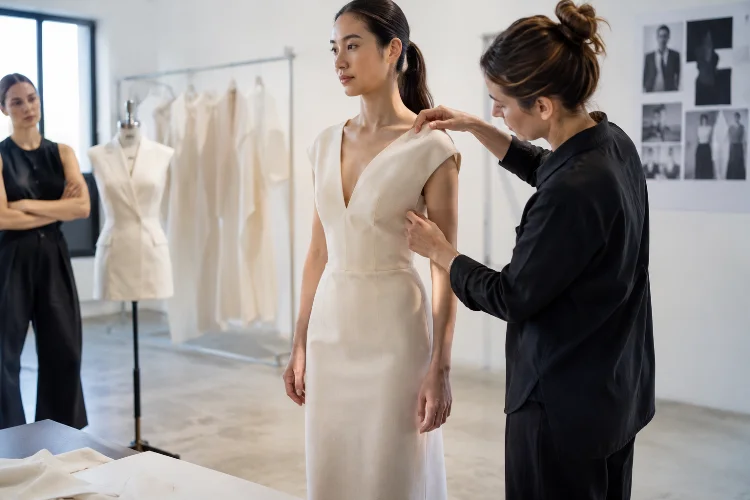
A garment can have beautiful fabric, creative details, and excellent sewing, yet still feel wrong when someone puts it on. Maybe the shoulders pull, the trousers twist, the neckline gaps, or the waist sits somewhere the designer never intended.
That is why garment fit matters so much.
Understanding garment fit and why it matters in fashion design helps designers create clothing that not only looks good in a sketch but also works on a real body.
Fit affects comfort, movement, silhouette, proportion, confidence, and even how expensive a garment appears.
Fashion schools treat fitting as a technical design skill rather than a final cosmetic adjustment. FIT, for example, teaches students to analyze proportions and balance on live professional models before correcting production patterns.
UAL similarly teaches designers to identify fitting problems on samples and transfer corrections from three-dimensional garments back into two-dimensional patterns.
For fashion students, learning fit means learning how body, fabric, pattern, and design intention work together.
1. What Does Good Garment Fit Actually Mean?
Good fit does not necessarily mean tight clothing.
A fitted evening dress, oversized coat, relaxed T-shirt, and wide-leg trouser can all fit correctly even though they have completely different silhouettes.
Good garment fit means the clothing behaves as the designer intended.
The garment should sit correctly on the body, provide appropriate movement, maintain the planned proportions, and avoid unintended pulling, twisting, sagging, or gaping.
UAL describes garment fitting as the process of understanding why fit problems occur, analyzing samples, taking accurate measurements, and making pattern adjustments to resolve them.
This distinction is important.
An oversized jacket may contain a large amount of extra volume, but its shoulder placement, sleeve balance, neckline, and overall proportion can still be carefully controlled.
Fit is therefore about intention, not simply closeness to the body.
2. Accurate Measurements Create the Foundation
Every successful fitting process begins with measurements.
Common body measurements include bust, waist, hip, shoulder width, back length, sleeve length, inseam, rise, and garment-specific dimensions.
However, taking measurements is not enough.
They need to be taken consistently and interpreted correctly.
UAL’s made-to-measure pattern cutting training includes measuring the body, compiling size information, drafting personalized blocks, creating toiles, and adjusting patterns according to fitting results.
Imagine two people with the same waist measurement.
One may have a longer torso, different hip distribution, broader shoulders, or a different posture. A pattern based only on one circumference cannot fully describe those differences.
This is why professional fitting combines measurements with visual observation.
Fashion students should also learn the difference between body measurements and finished garment measurements.
The garment measurement includes additional room, construction requirements, and design choices that determine how the clothing actually fits.
Poor measurments at the beginning can create problems that become increasingly difficult to fix later.
3. Ease Determines Comfort and Silhouette
One of the most important fitting concepts is ease.
Ease is the difference between body measurements and the measurements of the finished garment.
Some ease is functional.
A woven shirt cannot usually measure exactly the same as the wearer’s chest because the person still needs to breathe, move their arms, and sit comfortably.
Other ease is intentional design ease.
An oversized coat may contain significant extra width because volume is part of the visual concept.
UAL’s womenswear pattern-cutting training teaches students to manipulate patterns to create either additional ease or a tighter fit while also considering fabric choice and silhouette.
Positive and Negative Ease
Positive ease means the garment is larger than the corresponding body measurement.
Many shirts, jackets, and coats use positive ease.
Negative ease means the garment is smaller than the body measurement and relies on stretch to fit comfortably. Leggings, swimwear, and fitted knit tops often use this principle.
Understanding ease helps prevent a common beginner mistake: trying to solve every fit issue by simply adding or removing width.
Sometimes the problem is not size. It may be balance, length, fabric stretch, or pattern shape.
4. Balance Is Just as Important as Size
A garment can match the wearer’s measurements and still fit badly.
This often happens because of poor balance.
Balance describes how the garment hangs around the body. A correctly balanced jacket should not unintentionally swing toward the front or back, while side seams should remain close to their intended position.
FIT’s Fit Analysis and Technical Documentation course specifically focuses on evaluating both proportion and balance before making corrections to production patterns.
Imagine a skirt where the front hem appears shorter than the back even though both pattern pieces were designed with equal finished lengths.
Body shape, posture, or pattern construction may be influencing how the skirt hangs.
Similarly, trousers can twist if grainlines, leg shaping, or pattern balance are incorrect.
Designers therefore need to observe the garment from every angle.
Looking only at the front mirror view can hide problems at the side and back.
A strong fitting session involves examining the entire silhoutte rather than concentrating on one area.
5. Fabric Can Completely Change the Fit
A pattern does not behave the same way in every material.
Fabric weight, stretch, drape, thickness, recovery, stiffness, and shrinkage can all influence garment fit.
UAL’s garment fitting training specifically covers both woven and knitted fabrics and the limitations they create during sample development.
Imagine creating the same trouser pattern in rigid denim and stretch jersey.
The denim may require more wearing ease because the textile has limited flexibility. Jersey can stretch around the body, but it may also reveal problems such as sagging or poor recovery.
FIT’s technical design curriculum explores these relationships directly. Its courses examine how stretch, denim shrinkage, body measurements, pattern shape, and fabric characteristics affect pattern corrections and garment performance.
This is why designers should test patterns in fabric that behaves similarly to the intended final material.
A toile made from stiff cotton may not accurately predict how a soft silk dress will hang.
Fabric and fit should be developed together.
6. Fitting Sessions Reveal Problems Sketches Cannot Show
A fashion illustration can make almost any garment look perfect.
Real bodies are less predictable.
During a fitting session, the sample is placed on a fit model, client, mannequin, or appropriate wearer so the designer and technical team can evaluate what is working.
UAL teaches fitting as a process of identifying problems in samples, documenting them, making adjustments, and transferring those changes back to the pattern.
Common warning signs include drag lines, wrinkles, twisting seams, gaping necklines, restricted movement, uneven hems, or fabric pooling.
Not every wrinkle is automatically wrong.
Some folds are necessary for movement or deliberately created through design.
The challenge is learning to distinguish intentional volume from a technical fitting problem.
Photographs can be extremely helpful during this stage.
Take front, back, and side images before making corrections. This creates a visual record of what changed and can make repeated fitting sessions more systematic.
7. Pattern Corrections Turn Fit Feedback Into Solutions
Pinning a garment during a fitting is only temporary.
The real correction usually needs to happen in the pattern.
UAL describes professional fitting as a movement from three-dimensional samples back to two-dimensional pattern adjustments.
Its pattern cutting and draping course similarly includes fitting first prototypes, updating working patterns, and producing final industry-standard patterns.
Suppose excess fabric appears at the back waist of a dress.
The fitting team may pin out the excess, measure the adjustment, and then modify the corresponding pattern pieces.
If a sleeve feels restrictive, the solution may involve changing the sleeve cap, armhole, width, or balance rather than simply making the entire sleeve larger.
This is where technical knowledge becomes important.
A change in one area can affect another.
Lowering an armhole may influence sleeve movement. Shortening a shoulder can change the sleeve position. Increasing trouser rise can alter the relationship between waist and crotch.
Successful fit correction requires understanding these connections rather than making random alterations.
8. Fit Must Work Across Different Sizes and Bodies
Fashion brands rarely make garments for only one person.
Once a base sample is approved, patterns often need to be graded into multiple sizes.
FIT’s patternmaking program includes grading alongside fit analysis, sample making, and pattern development, highlighting how closely sizing and fit are connected in apparel production.
Grading does not simply mean enlarging every part of the pattern equally.
Different areas of the body change at different rates between sizes.
Designers and technical teams therefore need grading rules that protect the original proportion and intended silhouette.
This becomes even more complex because standardized size charts cannot represent every body shape.
Two customers who both purchase the same nominal size may have very different shoulder widths, bust proportions, torso lengths, or hip shapes.
That is one reason garment fit remains a major challenge for fashion brands.
The goal is not to create one pattern that perfectly matches every possible body. It is to develop a clear fit standard while understanding the limitations of standardized sizing.
9. Digital Fitting Is Becoming Part of the Process
Modern fitting is not limited to physical samples.
Fashion companies increasingly use 3D garment software and digital avatars to evaluate patterns before or alongside physical fittings.
FIT teaches computerized pattern corrections and 3D avatar fitting through platforms such as Browzwear, allowing students to analyze how different garment shapes and materials affect fit.
Digital fitting can help teams identify obvious proportion issues, compare pattern versions, and reduce unnecessary sample rounds.
It is especially useful when designers, factories, and technical teams work in different locations.
However, virtual fitting does not make physical knowledge irrelevant.
Software still depends on accurate body data, pattern information, and realistic fabric properties.
A designer who understands fit can use digital tools much more effectively than someone simply relying on the simulation.
Technology improves the process, but the fundamental relationship between body, pattern, and textile remains the same.
10. Better Fit Improves the Entire Garment Experience
Fit affects much more than appearance.
It influences comfort, movement, functionality, confidence, product quality, and whether a customer wants to wear the garment again.
FIT’s technical design courses connect body measurements, pattern shapes, production construction, garment fit, quality, and performance, demonstrating that these factors cannot easily be separated.
Imagine a beautiful tailored jacket that restricts arm movement.
A customer may admire it in the fitting room but rarely wear it afterward.
Poor fit can also create unnecessary returns, alterations, customer dissatisfaction, and production problems.
For designers, this makes fitting part of both creative and commercial decision-making.
A dramatic silhouette can still be successful, but the designer needs to understand how the wearer will move, sit, walk, and interact with the garment.
Good fashion should not only photograph well.
It should function as clothing.
Understanding garment fit and why it matters in fashion design helps designers create clothing that connects creative intention with real bodies.
Accurate measurements provide the starting point, while ease, balance, fabric behavior, fitting sessions, and pattern corrections determine how successfully the garment performs.
Fit is not a final adjustment added after the design is finished. It develops alongside the pattern, fabric, silhouette, and construction process.
If you are studying fashion, begin training your eye during every fitting. Photograph samples, identify drag lines, check seam positions, test movement, and record each pattern correction.
The more carefully you study how clothing behaves on the body, the easier it becomes to create garments that look intentional, feel comfortable, and maintain the designer’s original vision.