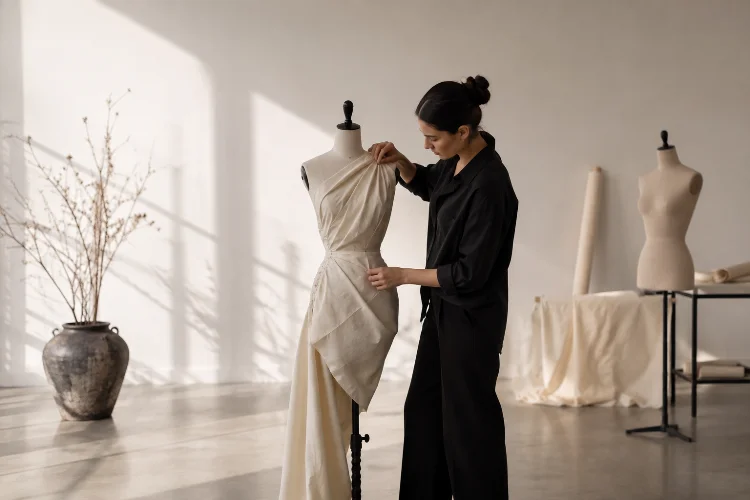
Sometimes the best fashion ideas do not begin with a pencil. They begin with a piece of fabric, a dress form, and a few pins.
Instead of drawing a garment first and figuring out its construction later, designers can place fabric directly on a mannequin and start shaping it around the body.
A fold becomes a neckline, excess fabric turns into volume, and an unexpected twist can lead to an entirely new silhouette.
This process is known as fashion draping, and it remains an important technique in fashion design because it lets designers work in three dimensions from the beginning.
At FIT, draping is taught as a way to creatively develop contemporary garments, from basic forms to structured and soft silhouettes.
For fashion students, draping is particularly useful because it connects creativity with technical understanding. It teaches you how fabric behaves, how clothing interacts with the body, and how a visual experiment can eventually become a usable garment pattern.
1. What Is Fashion Draping?
Fashion draping is a design and pattern-development technique in which fabric is arranged directly on a dress form or mannequin.
The designer pins, folds, gathers, twists, cuts, and marks the material until the desired shape begins to appear.
UAL describes 3D draping as a pattern-cutting method in which designers create forms directly in fabric before transferring the resulting shapes onto paper to produce patterns.
This makes draping different from conventional flat pattern cutting.
With flat pattern making, designers usually begin with two-dimensional blocks or templates and manipulate them mathematically or geometrically. Draping begins with the three-dimensional body.
Neither technique is automatically better.
In fact, professional designers often combine the two. Parsons teaches draping alongside pattern making, sewing, and garment construction as part of moving between 2D and 3D design processes.
The choice depends on the garment, fabric, and designer’s preferred way of working.
2. Draping Helps Designers Understand Fabric Behavior
One of the biggest advantages of draping is immediate feedback.
You can see what the fabric wants to do.
A stiff cotton may create strong architectural folds, while lightweight silk can fall softly around the body. Jersey stretches and follows curves differently from woven calico, while bias-cut fabric can create fluid movement.
UAL’s advanced draping training specifically covers fabric characteristics and explores materials including calico, muslin, and jersey across different silhouettes.
This matters because the same design can look completely different in two fabrics.
Imagine draping an oversized sleeve using crisp organza. The material may hold dramatic volume. Try the same shape in soft viscose, and the sleeve might collapse into flowing folds.
Draping therefore helps designers develop ideas according to real material behavior rather than assumptions.
For students, this is one of the fastest ways to improve fabirc awareness. You begin understanding weight, stretch, drape, grain, stiffness, and movement through direct experience.
3. Designers Can Discover Silhouettes They Never Sketched
Fashion draping can be surprisingly spontaneous.
When drawing, you generally control every line consciously. Draping introduces an extra participant into the process: the fabric itself.
You may begin trying to create one shape and discover something more interesting by accident.
Perhaps extra fabric falls into a dramatic cowl neckline. A twisted panel could create an unexpected asymmetric waist, or a fold at the shoulder might develop into a sculptural sleeve.
FIT teaches draping not only for basic garment construction but also as a method for designing original three-dimensional silhouettes.
This makes draping especially valuable for experimental fashion.
Work With the Fabric, Not Against It
A useful principle is to observe before forcing the material into position.
Pin one area and allow the remaining fabric to fall naturally. Rotate the dress form. Look at the design from the side and back rather than concentrating only on the front.
That three-dimensional perspective can reveal proportions that a flat sketch may hide.
It can also produce a more original silhoutte because the design evolves through interaction rather than following a completely predetermined outline.
4. Draping Makes Fit Easier to Understand
A dress form gives immediate information about how clothing relates to the body.
You can see where fabric pulls, where excess volume develops, and whether seams or darts need repositioning.
UAL’s pattern cutting and draping training includes fitting toiles, adjusting working patterns, and resolving garments after the draped form has been translated into a pattern.
This is particularly helpful when developing fitted bodices, dresses, skirts, collars, or unusual asymmetric designs.
Suppose you drape a fitted top and notice excess material around the waist.
Instead of guessing how much to remove on paper, you can manipulate the fabric directly, pin the excess into a dart, and immediately see the result.
Draping does not eliminate fitting problems, of course.
A mannequin is standardized and does not perfectly represent every real body. Finished prototypes still need to be tested on appropriate wearers or fit models.
However, draping makes the relationship between pattern shape and body shape much easier to visualize.
5. Draping Can Be Converted Into a Paper Pattern
A draped garment is not finished once it looks good on the mannequin.
If the design needs to be reproduced, the fabric pieces usually have to become patterns.
During draping, designers mark important information directly onto the material. This can include the neckline, waistline, center front, seams, darts, grainline, balance points, and other construction references.
The fabric is then carefully removed from the stand and flattened.
UAL teaches this exact process: marking the draped design, taking it off the mannequin, transferring it to paper, making adjustments, testing it through a toile, and producing a final professional pattern.
This stage reveals why draping and pattern cutting work so well together.
Draping discovers the three-dimensional form.
Pattern making organizes that discovery into accurate pieces that can be cut and sewn again.
Beginners should take careful measurments and markings before removing anything from the dress form. Missing a grainline or seam reference can make the flattened pattern much harder to interpret.
6. Draping Has a Long History in Innovative Fashion Design
Draping is not simply a classroom exercise.
Some of fashion history’s most influential designers used direct manipulation of fabric as an important creative method.
Madeleine Vionnet is one of the clearest examples.
The Metropolitan Museum of Art notes that Vionnet worked three-dimensionally on reduced-scale dress forms rather than relying primarily on sketching.
Her sensitivity to fabric and sophisticated use of the bias cut helped produce garments that moved fluidly with the body.
One surviving 1929 Vionnet evening dress demonstrates how her asymmetric draping allowed fabric to move around the body rather than restricting it.
Her work illustrates something important about draping.
The technique is not merely a way to execute an existing idea. It can generate the idea itself.
For modern designers, this means technical experimentation can become a source of creativity rather than simply the stage that follows creativity.
7. Draping and Flat Pattern Making Work Best Together
Students sometimes treat draping and flat pattern cutting as competing techniques.
In practice, knowing both provides much more flexibility.
Flat pattern methods are extremely useful when precision, repetition, controlled measurements, or systematic modifications are needed.
Draping becomes especially useful when the design depends on volume, fabric movement, asymmetry, unusual shapes, or direct experimentation.
UAL specifically teaches the combination of draping and flat pattern cutting as a method used to develop garments to professional standards.
Imagine designing a tailored dress with a conventional fitted bodice but an experimental draped skirt.
You could develop the bodice using a standard block and create the skirt directly on the mannequin.
Afterward, both sections can be transferred into finalized patterns.
Learning when to switch between methods is more valuable than trying to use one tecnique for every garment.
8. Draping Can Support More Sustainable Design Experiments
Draping can also become part of exploring fabric efficiency.
Traditional garment production can create waste when pattern pieces leave unusable gaps during cutting. UAL notes in its sustainable pattern-cutting training that an estimated 15% of textiles intended for clothing can end up on the cutting-room floor.
Zero-waste designers approach this problem differently.
Instead of automatically cutting conventional pattern shapes, they may experiment with rectangles, full fabric widths, folding, draping, and other methods designed to use more of the available textile.
Draping makes this easier to visualize.
A designer can start with a fixed amount of material and ask, “How can I transform all of this into the garment?”
The limitation becomes part of the creative challenge.
This does not mean every draped garment is sustainable. Fabric choice, production, durability, labor, and end-of-life considerations still matter.
However, draping can encourage designers to think more carefully about how fabric is distributed before cutting begins.
9. Beginners Should Practice With Simple Draping Exercises
You do not need to begin with an elaborate couture gown.
Start with a basic bodice.
Use inexpensive calico or muslin, identify the grainline, secure the fabric correctly on the dress form, and learn how to remove excess volume through darts or seams.
Then move to skirts.
Experiment with gathers, pleats, flare, asymmetric hems, and added volume.
UAL’s introductory draping courses follow a similar progression, moving from basic bodices toward skirts, tops, collars, darts, and more experimental shapes.
Photograph each experiment before removing it.
Even unsuccessful attempts are useful because they show what different amounts and directions of fabric can produce.
Also keep the resulting paper patterns.
Over time, you will build a library connecting three-dimensional shapes with the flat pattern pieces required to create them.
That connection is one of the most valuable skills draping can teach.
Understanding fashion draping and why designers use this technique reveals why working directly with fabric remains so valuable in modern fashion design.
Draping helps designers explore silhouettes, understand material behavior, evaluate fit, create unexpected forms, and translate three-dimensional ideas into workable patterns.
It also encourages experimentation. Instead of knowing exactly what a garment must become before starting, designers can allow fabric, gravity, proportion, and the body to influence the result.
If you are learning fashion design, begin with a simple piece of muslin and a dress form. Create a basic bodice, photograph it, transfer the markings onto paper, and repeat the exercise with a different fabric.
The more you drape, the more clearly you will understand the relationship between material, body, pattern, and design.