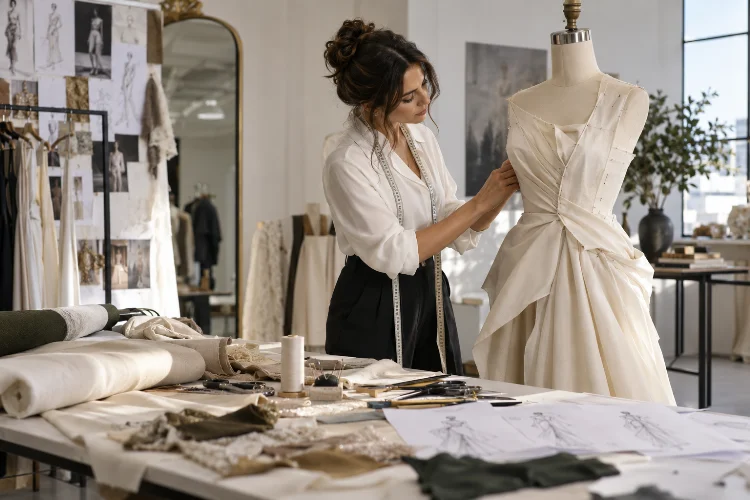
A finished runway dress can look effortless. The fabric flows perfectly, every detail feels intentional, and the entire outfit seems to have appeared from one brilliant idea.
In reality, professional fashion design rarely works that way.
Behind one successful garment can be weeks or months of research, sketching, fabric experiments, pattern development, fittings, revisions, and technical decisions.
Designers often discard more ideas than they eventually use. What appears simple at the end may have gone through dozens of changes along the way.
Understanding the creative process behind professional fashion design helps explain how a rough idea gradually becomes a wearable product.
It also shows why fashion design requires more than artistic talent. Designers must balance creativity with construction, materials, customer needs, cost, function, and manufacturing.
There is no single formula followed by every designer. Still, most professional workflows move through several recognizable stages, beginning with research and ending with a garment that can actually be produced, worn, and sold.
1. Professional Fashion Design Usually Starts With Research
Before drawing a collection, designers need something worth exploring.
Fashion research can come from almost anywhere: historical clothing, architecture, nature, photography, music, street culture, technology, art, social movements, or personal experiences.
The goal is not simply to collect attractive images. Good research helps a designer discover ideas that can be developed into shapes, colors, materials, and details.
Fashion Institute of Technology courses, for example, connect historical research with silhouettes, textiles, construction innovations, garment details, and contemporary design inspiration.
Professional designers also think about the market. Who will wear the clothes? Where will they wear them? What price range makes sense?
A designer creating performance running apparel will conduct very different reasearch from someone developing an experimental eveningwear collection.
This is where creativity becomes focused rather than random.
2. Mood Boards Turn Inspiration Into a Clear Direction
Once enough material has been collected, designers begin narrowing the idea.
A mood board is one of the most common tools used during this stage. It may contain photography, artwork, fabrics, textures, colors, silhouettes, objects, and other visual references that communicate the emotional direction of a project.
Adobe describes fashion mood boards as visual planning tools that can organize references such as fabric swatches, color palettes, silhouettes, and inspirational imagery before production begins.
The key is editing.
Imagine a designer researching coastal landscapes. They could collect hundreds of photographs, but the collection becomes stronger when they identify a specific story – perhaps weathered fishing equipment, faded blues, rough ropes, waterproof fabrics, and oversized protective shapes.
Suddenly, the inspiration has boundaries.
A proffesional mood board should guide decisions rather than simply look beautiful.
3. Designers Develop Silhouettes Through Sketching
With a concept established, designers start exploring what the clothing might actually look like.
Early sketches can be extremely loose. Designers may quickly draw dozens of silhouettes to test proportions, lengths, sleeves, collars, volume, and layering.
At this stage, quantity can be useful. Drawing twenty possibilities makes it easier to discover an interesting solution than spending hours perfecting the first sketch.
The strongest ideas are gradually refined.
FIT’s fashion design curriculum reflects this process by combining design-development sketching with silhouette, color, garment details, fabric rendering, and collection planning.
Designers also think about how different garments work together. A professional collection should usually feel connected without making every outfit identical.
One jacket might introduce a curved shoulder that later appears more subtly in a dress. A pocket shape may repeat across trousers and outerwear. A specific proportion could become part of the collection’s visual language.
This creates design coherence.
4. Fabric Selection Can Completely Change a Design
A sketch is only a possibility until material enters the process.
Fabric has weight, texture, stretch, structure, transparency, and movement. These properties influence how a garment behaves on the body.
Imagine designing the same wide skirt in stiff organza and soft jersey. The pattern may begin with a similar shape, but the final results would look completely different.
That is why textile selection is not something designers simply add at the end.
FIT’s draping curriculum specifically examines fabric characteristics and drapability because materials directly affect silhouette and style development.
Designers often collect swatches, test different materials, compare colors under various lighting conditions, and experiment with fabric manipulation.
They must also consider practicality.
Can the fabric survive repeated wear? Is it suitable for the intended climate? Can the desired seam or finish be constructed successfully? Is it available in sufficient quantities and at an appropriate cost?
Beautiful fabric that cannot function within the project is rarely the right fabric.
5. Patternmaking and Draping Turn Drawings Into Three Dimensions
This is where fashion becomes especially interesting.
A designer may draw an extraordinary jacket, but someone still needs to figure out how flat pieces of fabric can create that three-dimensional form.
Two major approaches are flat patternmaking and draping.
Patternmaking develops garment shapes mathematically and technically from blocks or existing patterns. Draping involves positioning fabric directly on a dress form and manipulating it until the desired shape emerges.
Designers frequently combine both methods.
Draping can be especially valuable for experimental shapes because unexpected folds and volumes sometimes emerge while physically working with the material. Patternmaking provides greater control when precise measurements and construction are required.
Neither approach is purely technical. Pattern development can influence creativity itself.
A design that looked exciting on paper may appear awkward when translated into fabric. Another idea that seemed ordinary in a sketch might become much stronger once its proportions are tested physically.
The process is iterative rather than perfectly linear.
6. Prototypes Reveal Problems That Sketches Cannot
Designers rarely move directly from drawing to final garment.
Instead, they create prototypes.
An early version may be made from inexpensive material such as muslin or calico so the team can study proportions and construction before cutting expensive fabric.
The garment is then placed on a dress form or fitted on a model.
This reveals things that are difficult to predict from drawings alone. Perhaps the armhole restricts movement. Maybe the hem feels too long, the collar collapses, or the waistline sits in the wrong position.
Professional fashion development therefore involves repeated adjustment.
FIT’s apparel courses connect proportion, silhouette, material selection, construction choices, planning, and fitting with the development of first prototypes.
Designers should not treat revisions as evidence that the original idea failed.
Revision is part of the creative process.
7. Fittings Refine Both Appearance and Function
A garment can look excellent on a mannequin and still feel uncomfortable on a human body.
That is why fittings matter.
During a fitting, designers and technical teams examine balance, movement, proportions, seam placement, length, comfort, and overall appearance.
Small changes can produce surprisingly large improvements.
Moving a shoulder seam slightly, reducing sleeve volume, or adjusting a waist measurement might make the entire garment look more balanced.
Designers also need to remember that garments eventually have to work across different sizes rather than only on one model.
This is where technical design becomes increasingly important. Measurements must be recorded accurately, patterns adjusted, and later samples checked against agreed specifications.
Creative instinct still matters, but precision becomes essential.
8. Technical Design Prepares the Idea for Manufacturing
A beautiful sample is not enough if a factory cannot reproduce it accurately.
Once the design has been refined, creative information must be translated into technical instructions.
One of the most important documents is the tech pack.
A typical tech pack can contain technical flat drawings, measurements, materials, construction instructions, color information, a bill of materials, and other specifications required by a manufacterer.
Techpacker describes the tech pack as the translation layer between the designer’s intention and what a factory needs to build the product.
This stage demonstrates why fashion designers need strong communication skills.
A factory cannot manufacture an idea such as “make the sleeve feel more dramatic.” It needs measurable instructions: sleeve length, circumference, seam construction, fabric type, gathering ratio, placement, and tolerances.
Creative thinking must eventually become specific.
9. The Creative Process Is Rarely a Straight Line
It is tempting to imagine fashion design as a simple sequence: research, sketch, fabric, pattern, sample, production.
Real projects are messier.
A fabric test might inspire a completely new silhouette. A fitting problem may send the designer back to pattern development. A supplier could discontinue a textile, forcing the team to reconsider the color story.
Even customer research can change a collection halfway through development.
A Parsons student fashion project, for example, documented a process involving customer insight, design thinking, extensive sketch development, fabric considerations, and refinement into a cohesive group of garments.
Professional creativity therefore depends partly on flexibility.
Strong designers do not simply protect their first idea. They know which parts of the concept are essential and which parts can change when better solutions appear.
Understanding the creative process behind professional fashion design reveals that successful clothing comes from much more than a beautiful sketch.
Designers research ideas, build mood boards, explore silhouettes, select textiles, develop patterns, create prototypes, conduct fittings, and translate the final design into precise production information. Along the way, concepts may change many times.
That combination of imagination and problem-solving is what makes fashion design so demanding – and so interesting.
If you are learning fashion design, try applying the same workflow to one simple garment. Start with a clear concept, document your inspiration, sketch several alternatives, experiment with fabric, and refine the design seperately at each stage.
Treat every revision as information, and you will begin thinking less like someone who simply draws clothes and more like a professional designer.