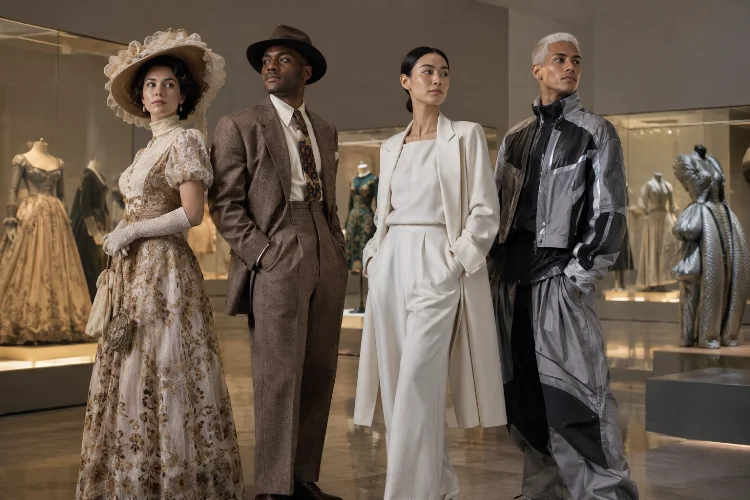
Open a family photo album from several decades ago and one thing becomes obvious almost immediately: people did not always dress the way we do today.
Clothing changes because the world around it changes. New technologies introduce different fabrics and production methods.
Social movements challenge ideas about gender, class, and identity. Music, movies, migration, politics, and even economic crises can influence what people decide to wear.
That is why understanding how fashion has evolved through culture, society, and innovation involves much more than looking at famous designers or runway trends. Fashion is also a record of how people have lived, worked, communicated, and expressed themselves.
A dress can reveal expectations about women in a particular era. A leather jacket can become a symbol of rebellion. A traditional textile can preserve cultural identity for generations.
From handcrafted clothing to mass production, youth subcultures, global streetwear, sustainable materials, and AI-assisted design, the history of fashion is really a story about people adapting to a constantly changing world.
Fashion Began as More Than Personal Style
Long before fashion became a global industry, clothing served practical, cultural, and social purposes.
People needed protection from climate and their environment, but garments also communicated information. Materials, colors, decoration, and construction techniques could indicate occupation, social position, community membership, religious tradition, or geographic origin.
Traditional clothing also developed through local knowledge. Communities learned which fibers were available, how fabrics could be woven, and what designs carried cultural meaning.
The Metropolitan Museum of Art notes that folk and regional dress has historically been important not only as cultural material but also as inspiration for modern designers.
This helps explain why fashion history cannot be reduced to a sequence of changing silhouettes. Clothing has always been connected to identity.
Even today, people may wear traditional garments during ceremonies, combine heritage textiles with modern clothing, or use fashion to maintain a connection with their cultural background.
Social Class Once Had a Much Stronger Influence on Fashion
For much of history, fashionable clothing was closely connected with wealth.
Complex garments often required expensive fabric, skilled labor, and significant amounts of time. People with money could afford custom-made clothes, while ordinary households frequently repaired, reused, altered, or produced clothing themselves.
European haute couture later turned this connection between luxury and fashion into a highly organized industry. Charles Frederick Worth, often described as a founder of haute couture, helped establish the practice of presenting seasonal collections to clients during the nineteenth century.
Fashion therefore became both creative expression and business.
However, the relationship between clothing and class gradually changed as manufacturing expanded. Mechanized textile production, standardized sizing, sewing technology, and factory systems made garments faster and cheaper to produce.
Clothing became increasingly accessble to people who previously could not participate easily in rapidly changing trends.
Mass Production Changed Who Could Participate in Fashion
Industrialization was one of the biggest turning points in fashion evolution.
Instead of every garment being created individually, manufacturers could produce larger quantities of textiles and clothing. Department stores, mail-order businesses, ready-to-wear garments, and eventually international retail chains brought fashionable styles to much wider audiences.
This democratization had an important cultural effect.
Trends were no longer controlled entirely by aristocrats or wealthy customers. Fashion increasingly responded to office workers, teenagers, suburban families, athletes, musicians, and other growing consumer groups.
The fashion business also became faster.
Manufacturers could observe popular styles and reproduce similar ideas for broader markets. Over time, this process helped create the enormous global apparel industry we recognize today.
Yet mass production introduced a contradiction that still shapes fashion. Making clothing cheaper allows more people to participate, but producing huge quantities of garments can also encourage overconsumption and waste.
That tension would become especially visible with the later growth of fast fashion.
Youth Culture Turned Clothing Into Rebellion
One of the most dramatic fashion changes occurred during the twentieth century when younger generations became powerful cultural and economic forces.
The 1960s provide a particularly clear example. According to the Victoria and Albert Museum, increasing spending power among young people helped create a distinct youth fashion market, while groups such as the Mods developed recognizable styles connected with music and identity.
Young consumers no longer wanted simply to dress like smaller versions of their parents.
Mini dresses, bold prints, experimental materials, informal silhouettes, and boutique shopping reflected broader social changes. Fashion became a visible way to reject older expectations.
The same pattern appeared repeatedly.
Punk transformed torn clothing, safety pins, leather, and DIY aesthetics into anti-establishment statements. Hip-hop influenced sneakers, oversized silhouettes, jewelry, and streetwear. Skateboarding, grunge, rave culture, and numerous other subcultures created their own visual languages.
The Met has documented how punk eventually influenced high fashion, showing how styles that begin outside elite fashion institutions can later enter luxury collections.
Fashion increasingly moved from the street to the runway – not only the other way around.
Social Change Redefined Gender and Identity in Fashion
Clothing has often reflected society’s expectations about gender.
Historically, many cultures developed clear distinctions between what men and women were expected to wear. But those boundaries have repeatedly been challenged as social attitudes changed.
Women’s clothing, for example, became connected with debates about mobility, work, independence, sexuality, and equality. As more women entered workplaces and public life, practical clothing became increasingly important alongside decorative fashion.
Menswear changed too. Different generations challenged ideas about masculinity through tailoring, color, hairstyles, jewelry, sportswear, and eventually gender-fluid design.
Today, fashion provides many people with a way to experiment with identity rather than simply conform to a fixed category.
Social media has accelerated this shift because individuals can now find communities accross geographic boundaries.
Someone experimenting with an unconventional style no longer depends entirely on local trends. They can discover creators, subcultures, and independent designers almost anywhere in the world.
Fashion has consequently become more personal while simultaneously becoming more global.
Globalization Made Fashion a Worldwide Conversation
Modern fashion constantly moves between cultures.
A silhouette developed in one city can appear on social media and influence consumers thousands of kilometers away within hours. Designers regularly draw inspiration from international art, craft, street style, music, and traditional clothing.
This cultural exchange can produce exciting creativity.
However, it also raises important questions about cultural appreciation and cultural appropriation. There is a major difference between respectfully collaborating with craftspeople or understanding a tradition and simply copying culturally significant designs without context or recognition.
Globalization also transformed the fashion supply chain.
A garment might be designed in Europe, use cotton grown in another region, be woven somewhere else, assembled in an Asian manufacturing center, and finally sold worldwide.
Fashion has therefore become one of the clearest examples of how interconnected modern economies are.
Consumers increasingly want to know not only what a garment looks like, but also who made it and under what conditions.
Technology Keeps Reinventing How Fashion Is Created
Innovation has always shaped clothing, from improved looms and sewing machines to synthetic fibers and modern manufacturing.
Today, the transformation is increasingly digital.
Computer-aided design allows designers to experiment with garments before creating physical samples. 3D tools can simulate fabrics and silhouettes, while digital supply-chain systems help companies manage production and inventory.
Artificial intelligence is becoming another major influence. McKinsey’s State of Fashion 2026 describes AI as part of the rapidly changing technological landscape fashion companies are now navigating.
Technology is also changing how people discover fashion.
Instead of waiting for magazines or seasonal catalogues, consumers now encounter trends through TikTok, Instagram, online marketplaces, influencers, livestreams, and recommendation algorithms.
A small independant designer can potentially reach an international audience without operating hundreds of physical stores.
At the same time, innovation is blurring the boundary between physical and digital fashion through virtual clothing, augmented-reality fitting experiences, digital sampling, and experimental wearable technology.
Sustainability Is Shaping the Next Stage of Fashion
Fashion innovation is no longer only about making clothing faster or more attractive.
It is increasingly about reducing damage.
The environmental scale of the textile industry has pushed sustainability into mainstream fashion discussions. UNEP estimates that textiles are responsible for roughly 2–8% of global greenhouse gas emissions and consume enormous quantities of water.
This has encouraged interest in recycled fibers, lower-impact materials, resale platforms, clothing rental, repair services, traceable supply chains, and circular design.
Circular fashion tries to move away from the traditional model of producing, buying, using, and discarding garments. Instead, products are designed with longer life cycles, reuse, recycling, or material recovery in mind.
UNEP has also emphasized the need for the textile value chain to move toward a more circular system.
The transition remains difficult. Sustainable materials alone cannot solve every enviromental problem if consumers and businesses continue treating clothing as disposable.
Future progress will probably depend on innovation combined with changes in production habits and consumer behavior.
Fashion has never evolved in isolation. Every major change in clothing reflects something larger happening in culture, society, technology, or the economy.
Traditional garments preserved community identity. Industrialization made fashionable clothing available to broader populations.
Youth movements transformed style into rebellion, while globalization turned fashion into an international exchange of ideas. Digital technology and sustainability are now pushing the industry into another period of transformation.
Understanding how fashion has evolved through culture, society, and innovation also helps us see clothing differently. What we wear is not simply decoration. It can reveal where society has been and where it may be heading next.
The next time you notice a new trend, look beyond the garment itself. Ask what social change, cultural influence, or new technology helped bring it into existence.