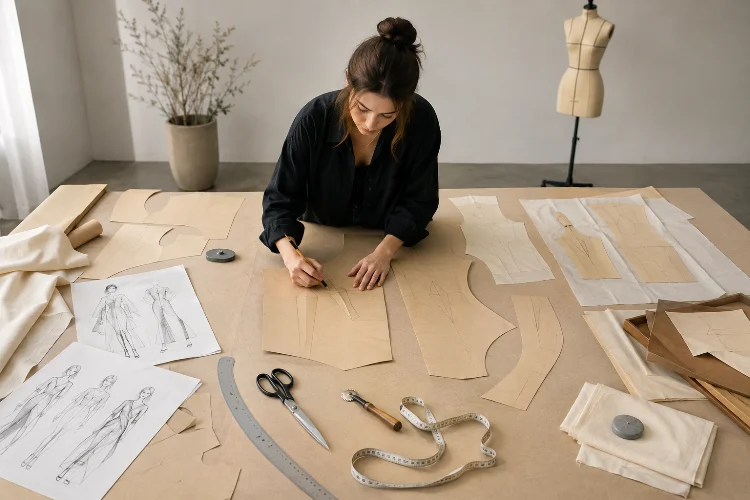
A fashion sketch can show a beautiful silhouette, dramatic sleeve, or unusual neckline, but a drawing alone cannot tell fabric exactly how to become that garment.
Somewhere between the creative idea and the finished piece, the design needs to be translated into shapes that can actually be cut, sewn, fitted, and reproduced.
That is where pattern making comes in.
Understanding pattern making and its role in fashion design is essential because patterns form the technical foundation of most garments.
They determine shape, proportion, fit, seam placement, volume, and how individual fabric pieces connect around the body. Fashion schools treat pattern development as a core technical skill for this reason.
Parsons combines pattern making with draping, sewing, and garment construction, while the Fashion Institute of Technology connects pattern development with fit, balance, specifications, grading, and production.
For beginners, pattern making can initially look mathematical and intimidating. In practice, however, it is a creative problem-solving process that helps turn two-dimensional ideas into wearable three-dimensional clothing.
1. What Is Pattern Making in Fashion Design?
Pattern making is the process of creating templates that represent the individual pieces needed to construct a garment.
A simple shirt pattern, for example, may contain front and back body pieces, sleeves, collar components, cuffs, facings, and other sections. Each piece includes information that helps the maker cut and assemble the fabric correctly.
University of the Arts London describes pattern cutting as a key part of fashion design and manufacturing, involving the development and manipulation of patterns to achieve specific style lines, silhouettes, and fit.
Patterns are normally developed on paper or digitally before fabric is cut.
They may begin from standard measurements, an existing block, body measurements, draping, or computer-based pattern systems.
The important point is that the pattern translates the designer’s visual idea into technical geometry.
Without accurate patterns, even a visually impressive concept may become difficult to construct consistently.
2. Blocks and Slopers Provide the Starting Structure
Many patterns begin with a block, also called a sloper.
A block is a basic pattern developed to fit the body without decorative design details. It creates a starting structure for garments such as bodices, skirts, sleeves, trousers, or jackets.
UAL’s introductory pattern-making courses teach students to work from basic blocks and then modify them to create new garment styles.
Imagine you have a basic bodice block.
You can change the neckline, move darts, add fullness, create princess seams, extend the length, introduce panels, or transform the basic shape into a completely different garment.
This makes blocks incredibly useful because designers do not have to draft every style from zero.
Dart Manipulation Creates New Design Possibilities
A dart removes excess fabric so a flat material can follow the curves of the body.
However, darts are not fixed permanently in one position.
Through techniques such as pivoting, slashing, and spreading, designers can move or transform them while maintaining the necessary shaping.
A bust dart might become a shoulder dart, waist dart, curved seam, gather, or pleat.
UAL includes dart manipulation among the fundamental pattern-cutting skills used to create different garment designs.
This is where pattern making becomes clearly creative rather than purely technical.
3. Pattern Making Translates 2D Ideas Into 3D Garments
One of the most important roles of pattern making is connecting a flat drawing with the three-dimensional human body.
The human body contains curves, angles, changing proportions, and movement. Fabric begins as a flat surface.
The pattern cutter needs to make those two systems work together.
Parsons’ Technical Studio teaches students to move between two-dimensional and three-dimensional methods through pattern making, draping, sewing, and garment construction.
Suppose a designer sketches a jacket with unusually rounded shoulders.
The pattern maker must determine how much extra volume is needed, where seams should sit, whether internal support is required, and how the sleeve should connect to the armhole.
The original silhoutte may look simple on paper, but creating it physically can require several pattern adjustments.
This translation process is one reason designers benefit from pattern-making knowledge even when they eventually work with specialist pattern cutters.
Understanding construction makes ambitious ideas easier to communicate and develop.
4. Fit and Balance Depend Heavily on Accurate Patterns
Fit problems often begin with pattern problems.
If a shoulder seam sits too far back, trousers twist around the legs, or a dress pulls awkwardly across the bust, adjusting the sewing alone may not solve the issue.
The pattern itself may need correction.
FIT teaches pattern making with strong emphasis on fit, balance, body slopers, specification measurements, and production-quality patterns.
Balance refers partly to how the garment hangs correctly around the body.
For example, a jacket should not unintentionally swing toward the front or back. Side seams should usually sit where intended, and hems should maintain their planned position.
During fitting, designers and pattern makers observe these issues and modify the pattern.
They may adjust length, width, dart placement, shoulder slope, armhole shape, or ease.
FIT’s fit-analysis training also involves evaluating garments on live industry models and making corrections directly to production patterns.
Accurate measurments therefore matter, but good fit involves more than numbers. It also requires understanding how those measurements interact with posture, movement, material, and design intent.
5. Draping Offers Another Way to Develop Patterns
Flat pattern making is not the only way to create garment shapes.
Designers can also use draping, which involves placing and manipulating fabric directly on a dress form or body.
UAL describes draping and pattern cutting as complementary methods used throughout garment development, from initial shape creation to toiling and fitting.
Draping can be especially useful for fluid, asymmetric, sculptural, or experimental designs.
A designer might begin with a rectangular piece of fabric and manipulate it until an interesting fold or volume appears.
The resulting shape can then be marked, removed from the dress form, flattened, and converted into a usable pattern.
Cornell University’s patternmaking and draping resources similarly demonstrate how three-dimensional fabric manipulation can be balanced, fitted, and translated into patterns related to the curves of the human body.
Some designers prefer flat pattern techniques, others work heavily through draping, and many combine both.
The strongest aproach depends on the garment and the designer’s creative process.
6. Toiles and Samples Help Test the Pattern
A pattern should usually be tested before expensive final fabric is cut.
Designers commonly create a toile or muslin sample using inexpensive fabric.
This prototype reveals problems that may not be obvious on paper.
Perhaps the sleeve is too narrow. Maybe a neckline gaps away from the body. A pocket may sit too low, or the overall garment may contain more volume than expected.
UAL teaches students to produce shell toiles specifically to check pattern accuracy and fit.
Testing also allows designers to evaluate proportion.
A collar that looks elegant in a small sketch might appear enormous on an actual body. A dramatic sleeve may overpower the entire garment.
The pattern is then corrected and another sample may be made.
This repeated cycle of pattern, toile, fitting, and correction is a normal part of garment development.
Professional results rarely come from the first version.
7. Pattern Grading Makes Multiple Sizes Possible
Once a pattern fits correctly in one base size, brands often need to create additional sizes.
This process is called pattern grading.
Grading systematically increases or decreases different areas of a pattern according to established measurement rules.
It is not simply a matter of making every piece equally larger.
FIT teaches pattern grading through the study of body measurements and proportional changes across different sizes.
For example, when grading trousers from one size to another, the waist, hip, rise, leg width, and other areas may change by different amounts.
The aim is to preserve the original design and fit characteristics across the size range.
Grading is therefore essential for ready-to-wear fashion.
A designer creating only one custom garment might develop a pattern directly for one person’s body, while a commercial brand needs patterns that work across multiple standardized sizes.
Poor grading can create inconsistent fit even when the original base pattern was successful.
8. Digital Pattern Making Is Changing the Workflow
Pattern making increasingly happens on computers as well as paper.
Digital systems allow pattern makers to create, modify, store, grade, and organize patterns with greater efficiency.
FIT currently teaches computerized pattern development, grading, marker making, and 3D virtual fitting as part of technical design and pattern-making education.
Digital workflows can reduce repetitive manual work.
A pattern can be adjusted, duplicated, graded, and prepared for manufacturing without redrawing every piece by hand.
Some systems can also simulate garments on digital avatars.
This allows teams to evaluate basic proportion or fit before producing physical samples, although real fabric testing and physical fittings may still be necessary.
Digital technology does not eliminate the need to understand pattern principles.
Software can move a seam or change a measurement quickly, but the user still needs to understand why the change is necessary.
Technical knowledge remains the foundation.
9. Pattern Making Also Influences Production and Cost
Patterns affect more than design and fit.
They also influence how efficiently garments can be manufactured.
When pattern pieces are arranged on fabric for cutting, the layout is called a marker. Efficient marker planning can reduce fabric waste and production costs.
FIT specifically connects marker making with garment costing and mass-production efficiency.
Imagine two jackets using exactly the same fabric.
One design may require unusually shaped pieces that leave large unused spaces during cutting. Another may use shapes that fit together efficiently.
The second garment could require less material even if both appear similar in size.
Pattern complexity can also affect sewing time.
A garment containing thirty individual panels may require more labor than a similar silhouette made from eight pieces.
This means pattern development sits at the intersection of creativity, engineering, sustainability, and business.
A technically smart pattern can help protect the design while improving fit, reducing waste, and making production more practical.
Understanding pattern making and its role in fashion design helps explain how creative ideas become real garments.
Patterns translate sketches into cuttable pieces, control fit and balance, guide construction, support sampling, and make size grading and production possible.
Learning the basics also gives designers more creative freedom. Once you understand blocks, darts, grainlines, seam allowances, draping, and fit corrections, you can manipulate them rather than treating garment construction as a mystery.
If you are studying fashion, start with one basic block and experiment with it. Move a dart, change a neckline, add volume, create a toile, and observe what happens in three dimensions.
The more you practice pattern development, the easier it becomes to design clothing that works not only on paper, but also on the body.