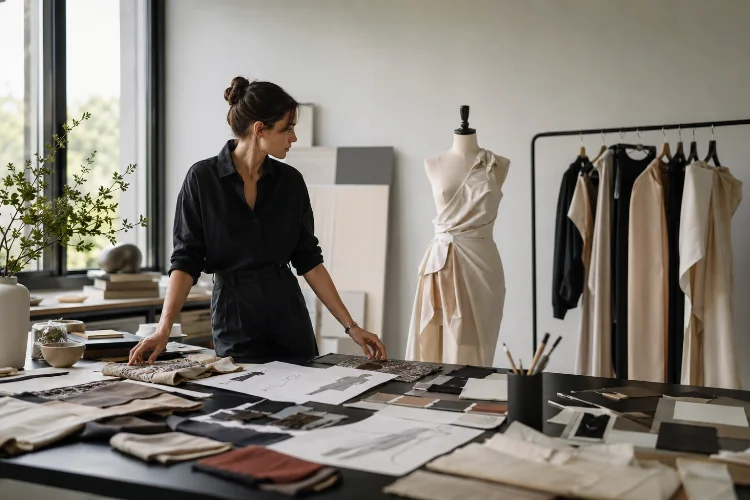
A strong fashion collection rarely begins with someone randomly sketching ten beautiful outfits.
Before the first garment takes shape, designers usually spend time researching ideas, studying materials, experimenting with silhouettes, testing construction techniques, and deciding what story they actually want to tell.
That is why learning how to develop a fashion design concept from research to collection is such an important skill for fashion students and emerging designers.
A concept gives individual garments a shared direction. Without one, a collection can easily become a group of attractive pieces that have little connection to each other.
Professional fashion education reflects this approach. Parsons, for example, places research, material exploration, visual communication, and technical development at the center of its fashion curriculum.
The process does not have to be mysterious. By moving through research, concept definition, visual development, experimentation, prototyping, and editing, you can gradually turn a loose source of inspiration into a collection that feels thoughtful and cohesive.
1. Start With Research Before You Start Designing
Good fashion research is more than collecting attractive images from social media.
Research should help you discover something. You might begin with architecture, family photographs, nature, music, historical clothing, political movements, traditional crafts, technology, film, or even an everyday object.
Parsons specifically teaches fashion students to explore materials, libraries, historical archives, cultural issues, trends, heritage, and environmental contexts as part of the research process.
Primary research can be especially valuable. Instead of searching only online, photograph buildings, visit exhibitions, interview people, collect textures, draw objects, study old garments, or document environments.
For example, imagine developing a collection inspired by abandoned coastal buildings. Your reserach might include photographs of cracked concrete, rusted metal, faded paint, ocean erosion, old construction plans, and weathered surfaces.
These observations already contain possible fashion ideas: distressed textures, washed colors, structural seams, layered surfaces, and irregular shapes.
The goal is not to know exactly what the garments will look like yet. Research should open possibilities rather than immediately close them.
2. Turn Your Research Into a Clear Fashion Concept
After gathering information, you need to identify the strongest ideas.
This is where research becomes a fashion design concept.
Ask yourself what connects your references. Is the collection really about abandoned buildings, or is it about decay and renewal? Is it about the ocean, or about movement and changing surfaces?
A good concept usually goes deeper than the obvious subject.
Try writing a short concept statement of two or three sentences. It should explain your inspiration, emotional direction, and what you want to investigate through clothing.
For instance:
The collection explores how coastal structures are gradually transformed by weather and time. Layered surfaces, faded colors, exposed construction, and shifting shapes will influence the garments.
Once you can explain the idea clearly, making design decisions becomes easier.
Your concept becomes a filter. When you later consider adding a bright floral print or highly polished fabric, you can ask whether it genuinely supports the original story.
3. Build a Mood Board That Guides Design Decisions
Mood boards are common in fashion, but not every mood board is useful.
A weak board is simply a collection of beautiful photographs. A strong board establishes a visual language.
Look for recurring colors, shapes, textures, proportions, details, materials, and emotions within your research. Then edit your images until those connections become visible.
Avoid Making the Mood Board Too Literal
If your concept is inspired by architecture, you do not necessarily need to print buildings directly onto clothing.
Instead, consider what architectural qualities can become fashion elements.
A curved staircase might inspire a spiral seam. Concrete panels could influence garment construction. Repeating windows might become a pocket arrangement, while damaged surfaces could inspire textile manipulation.
UAL’s Central Saint Martins fashion design teaching similarly encourages students to interpret research through print, textile development, silhouettes, shapes, draping, and other forms of experimentation before refining those ideas into a collection.
That translation is what separates inspiration from imitation.
4. Develop Silhouettes Before Adding Too Many Details
Once the visual direction is clear, start exploring shape.
Create many quick sketches rather than immediately trying to produce perfect fashion illustrations. At this stage, quantity can help you discover unexpected possibilities.
Experiment with length, volume, shoulder width, waist placement, sleeve shapes, layering, and relationships between the upper and lower body.
You might also create silhouette collages using cut paper or manipulate fabric directly on a mannequin.
Parsons’ Collection pathway combines research with 2D and 3D design development and encourages students to find technical solutions that support a clearly defined visual aesthetic.
Do not become emotionally attached to your first sketch.
Perhaps twenty sketches contain only three strong ideas. Those three can then be expanded into twenty more variations.
Fashion developement often works through repetition. You discover an interesting shape, exaggerate it, reduce it, combine it with another shape, and gradually understand which version communicates your concept most effectively.
5. Develop Fabrics, Colors, and Details Alongside the Silhouette
A garment’s material should not be an afterthought.
Fabric can completely change how a design behaves. A dramatic oversized sleeve in stiff cotton creates a different effect from the same sleeve made from lightweight silk.
That means silhouette and material development should happen together.
Create a small fabric library related to your concept. Test weight, texture, stretch, transparency, drape, surface treatment, and movement.
If your collection explores erosion, for example, you might experiment with frayed edges, layered translucent materials, washed denim, distressed surfaces, or irregular stitching.
Material choice also creates environmental and production consequences. The CFDA recommends considering not simply whether a material appears sustainable, but also its sourcing, processing, intended use, lifecycle, and eventual end of life.
At the same time, develop a controlled color palette.
You do not need fifteen unrelated colors. A limited group of carefully selected shades can make a collection feel much more connected.
6. Move From Sketches Into Draping and Prototypes
Eventually, ideas must leave the sketchbook.
This is where technical experimentation becomes essential.
Fashion designers use patternmaking, draping, sewing, and garment construction to discover whether a concept can actually work in three dimensions.
Parsons’ Technical Studio specifically connects research outcomes with the process of building and manipulating garments through 2D and 3D methods.
Some ideas will improve when translated into fabric. Others may fail completely.
That is normal.
Suppose your sketch includes an enormous sculptural shoulder. Once you create a toile, you might discover that the original silhoutte restricts movement or collapses under the fabric’s weight.
Instead of abandoning the idea, revise the internal structure, reduce the volume, change materials, or reposition the shape.
Prototyping is not simply about confirming your design. It is a way of discovering the design.
7. Build a Collection Instead of Designing Separate Outfits
One of the hardest steps is making individual looks feel like part of the same world.
A collection needs repetition and variation.
You might repeat a certain seam direction across several garments, use the same textile treatment in different ways, or develop one silhouette across jackets, dresses, and tops.
However, avoid making every look almost identical.
Think of the collection like a conversation. Some outfits can introduce an idea, others develop it, and a few can push it to its most dramatic expression.
FIT’s fashion curriculum emphasizes designing coordinated groups and developing collections through research, garment silhouettes, presentation, target-market analysis, and editing.
Lay all your designs next to each other.
Does one garment suddenly look like it belongs to another project? Does the entire collection use the same length? Is there enough variation in volume? Are your strongest ideas repeated enough to establish an identity?
Seeing everything together makes these problems much easier to identify.
8. Edit Ruthlessly and Prepare the Final Collection
Editing is one of the most underrated fashion design skills.
More designs do not automatically create a stronger collection.
Remove garments that do not support the concept. Simplify unnecessary details. Strengthen weak looks and check whether the range includes enough variety while still maintaining visual consistency.
FIT’s senior portfolio courses specifically emphasize researching, analyzing, and editing the directional components of fashion collections, showing that refinement is an essential part of professional collection development.
You should also consider practical questions.
Who is the customer? What occasions are these garments designed for? What would they cost? Are the fabrics realistic for the intended market? Can the pieces be produced?
Finally, prepare your presentation carefully.
Show your research, mood board, textile experiments, sketches, technical development, prototypes, final lineup, and finished garments. The process matters because it demonstrates how your thinking evolved.
A successful collection is not just proof that you can make clothes. It shows that you can investigate an idea and transform it into a coherent design language.
Learning how to develop a fashion design concept from research to collection is really about learning how to make creative decisions with purpose.
Research gives you material to explore, the concept creates direction, and mood boards help translate abstract ideas into visual language.
From there, silhouette development, fabrics, draping, prototyping, fitting, and editing gradually turn those ideas into garments that belong together.
Do not rush toward polished final illustrations too quickly. Give yourself permission to experiment, make weak sketches, test strange materials, create unsuccessful samples, and change direction when necessary.
Start your next project with one subject you genuinely want to investigate. Build meaningful research around it, identify the strongest visual clues, and keep developing them until they become unmistakably yours.